It does not always make sense to remove old plaster “down to the brick.” In many cases, a facade can be renovated over the existing finish — faster, cleaner, and more affordably. But the key word here is can: first, you need to understand whether the old substrate can support the new system.
Below is a practical diagnostic approach, which types of substrates are usually suitable, and which limitations must be considered.
1) Where the decision starts: substrate inspection
Before any “renovation over the existing surface,” you need to answer 3 questions:
- is the substrate stable, or is it “moving on its own”?
- is there moisture inside the wall or between the layers?
- how even is the facade, and what will need to be leveled?
If there are delaminations, hollow spots, or a drummy sound when tapped, renovation over the top is not an option — the problem will simply transfer into the new layer.
2) Quick test: when the old finish should not be left in place
There are clear signs when it is better not to take the risk:
- the old plaster is crumbling, powdering, or easily detaching
- there are large cracks that are still “active”
- there are постоянные wet zones, mold, or visible water damage on the facade
- there are many hollow areas (it sounds hollow when tapped)
- the surface was painted with a “slippery” coating that has poor adhesion
In these cases, the correct solution is to remove the weak areas and rebuild the substrate properly.
3) Which substrates are most often suitable for renovation “over” the old finish
Usually, the existing finish can remain when it is:
- strong and well bonded
- free from постоянная moisture problems
- without widespread hollow spots
- with predictable adhesion (so it can be properly primed)
This is exactly where renovation without demolition offers the greatest advantage: less waste, faster completion, and fewer “wet” construction processes.
4) Limitations: what must be taken into account
Evenness
If the walls are wavy or uneven, the new finish will not fix that by itself. In some cases, partial leveling is necessary, otherwise the facade will still look crooked even if the finishing material is high quality.
Moisture
If the source of moisture has not been eliminated (leaks, incorrect flashings, a damp plinth), the new facade will begin to “age” quickly.
Detail junctions
In renovation projects, junctions matter even more: connections to windows, the plinth, cornices, canopies. If these areas are not thought through properly, the facade will remain problematic regardless of the material used.
5) If insulation is planned — that is a different system altogether
Sometimes people want to add insulation over the old facade as well. In that case, this is no longer just “renewing the outer layer,” but a full facade system. Here, Facade Insulation must be treated as a separate build-up: substrate, insulation board, reinforcing layer, junction detailing, and only then the final finish.
6) What works well as a finish for renovation without demolition
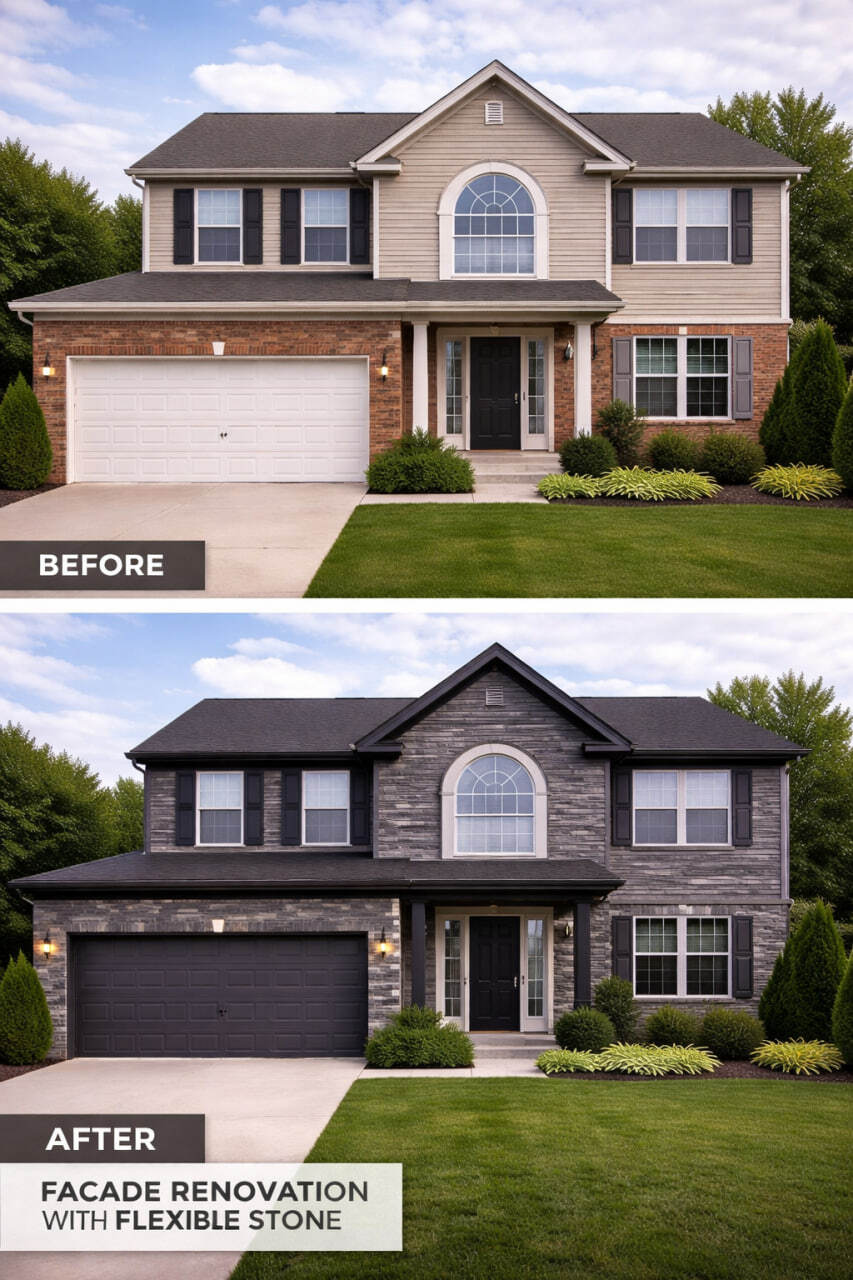
In renovation, two things matter most: predictable installation and a neat appearance around difficult areas. That is why KORDEKO Flexible Tile (PletaFlex) is often chosen as a finish over a properly prepared substrate: it provides the texture of a real material, helps mask minor surface imperfections, and allows corners and reveals to be finished neatly without heavy structures.
Mini-checklist: can you renovate over the existing finish?
In simple terms, the answer is “yes” when:
- the old coating is solid and not hollow
- there is no permanent moisture problem
- the surface can be properly primed
- details such as windows, plinth, and flashings will be done correctly
And the answer is “no” when:
- there is widespread delamination or crumbling
- water is already damaging the wall
- the cracks are active and continue to grow
Conclusion
Renovation without demolition is a great way to update a facade quickly, provided the old substrate is truly reliable. The main thing is not to skip the inspection stage and not to cover up moisture problems with a “beautiful finish.” When done correctly, the result is fast, clean, and durable.
KORDEKO Contacts
📱 Phone: +37368140333
🌐 Website: www.kordeko.com
📧 Email: kordeko.md@gmail.com