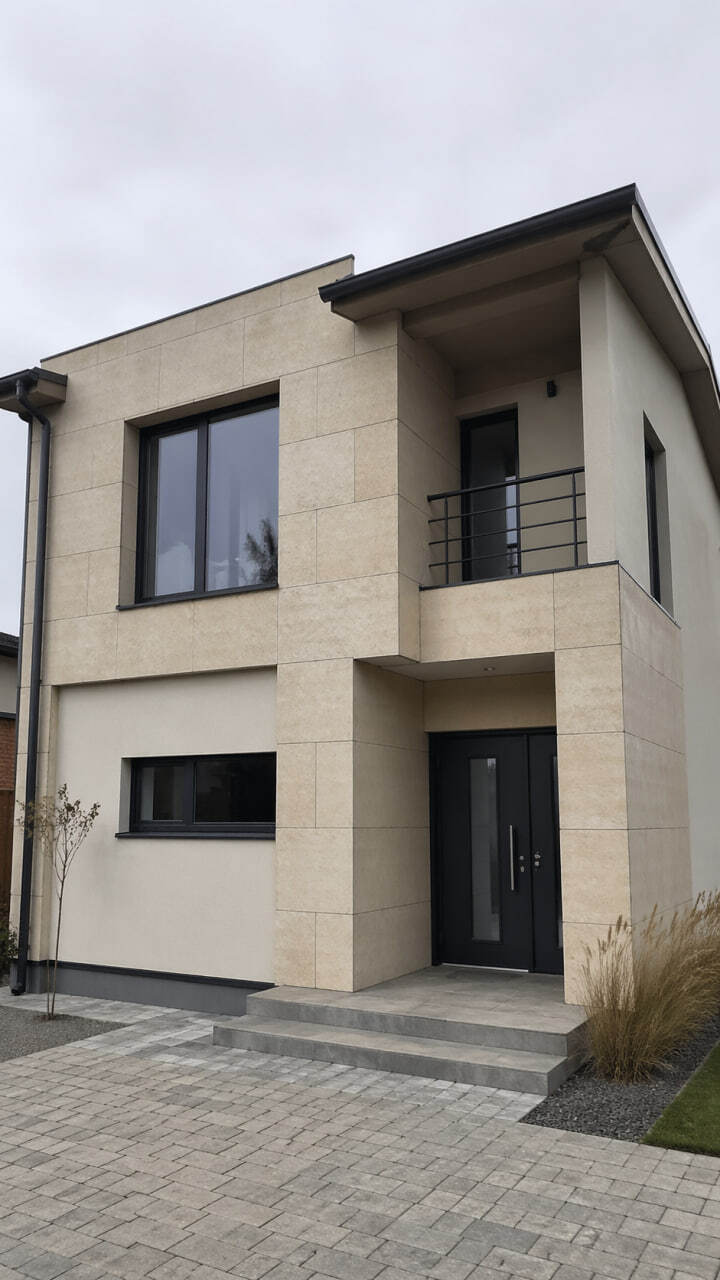
The cladding format matters just as much as color and texture. It defines the rhythm of the facade, the number of joints, and the speed of installation. The same “stone” can look completely different: a large format creates a calm, modern surface, while a small module gives a more “lively” masonry effect and expressive visual pattern.
Below is a simple guide to help you choose the right format for your project.
1) Visual effect: what you want to see on the facade
Large sheet — a “monolithic” modern look
Suitable if you want:
- less visual fragmentation
- clean, large surfaces
- modern architecture and minimalism
A large format visually “calms” the facade and makes the house look more unified.
Small module — expressive rhythm and a “lively” look
Suitable if you want:
- a masonry effect
- more visible texture from a distance
- a cozy, more classic or “European” character
A small format makes the facade more dynamic and helps hide minor irregularities in the base surface.
2) Joints: how many there will be and how they affect the look
Joints are not only about aesthetics, but also practicality.
- Large format: fewer joints, so the facade looks cleaner.
- Small module: more joints, but you can achieve a beautiful “brick” rhythm and neatly work around details.
Important: the more details there are on the facade — windows, reveals, corners — the more important joints and cutting become.
3) Installation speed: where it is actually faster
Speed depends on the geometry of the house:
- On large, flat surfaces, a large format is usually faster: fewer elements and fewer operations.
- On complex facades with many openings, corners, and junctions, a small module can sometimes be more practical: fewer complicated cuts “on every sheet” and easier adjustment.
From an installation point of view, in any format, the key factors are proper surface preparation, primer, and compliance with the technology — otherwise speed can turn into rework.
4) Where each format is most often chosen
Large format is usually chosen for:
- modern houses with large surfaces
- accent walls without many windows
- areas where a “clean” appearance is desired
Small module is usually chosen for:
- facades with many details
- entrance areas, wall sections, and accent inserts
- projects where a masonry effect is important
5) Common mistakes when choosing the format
- choosing a large format for a facade with many small windows and details — resulting in many complicated cuts
- choosing a small module for a large house and making the facade look too visually fragmented
- not planning joints and junctions in advance
6) If the facade includes insulation, choose the format before work begins
When doing Facade insulation, the cladding format affects junctions and layout. If the format is selected in advance, it becomes easier to plan proper connections and avoid “random” decisions on site.
Why choosing the format is easier when the material is “technological”
In practice, the format must be not only beautiful, but also convenient to work with — on corners, reveals, transitions, and complex areas. That is why many choose KORDEKO Flexible Tile (PletaFlex): it allows working with both large surfaces and modules while maintaining a neat result with proper preparation.
Conclusion: a short selection formula
- if you want a modern, “calm” facade with large surfaces — a large format is usually the better choice
- if you want a masonry effect, more rhythm, and easier detailing — a small module is usually more suitable
- if there are many junctions and openings — think not only about beauty, but also about cutting and joints
KORDEKO Contacts
📱 Phone: +37368140333
🌐 Website: www.kordeko.com
📧 Email: kordeko.md@gmail.com