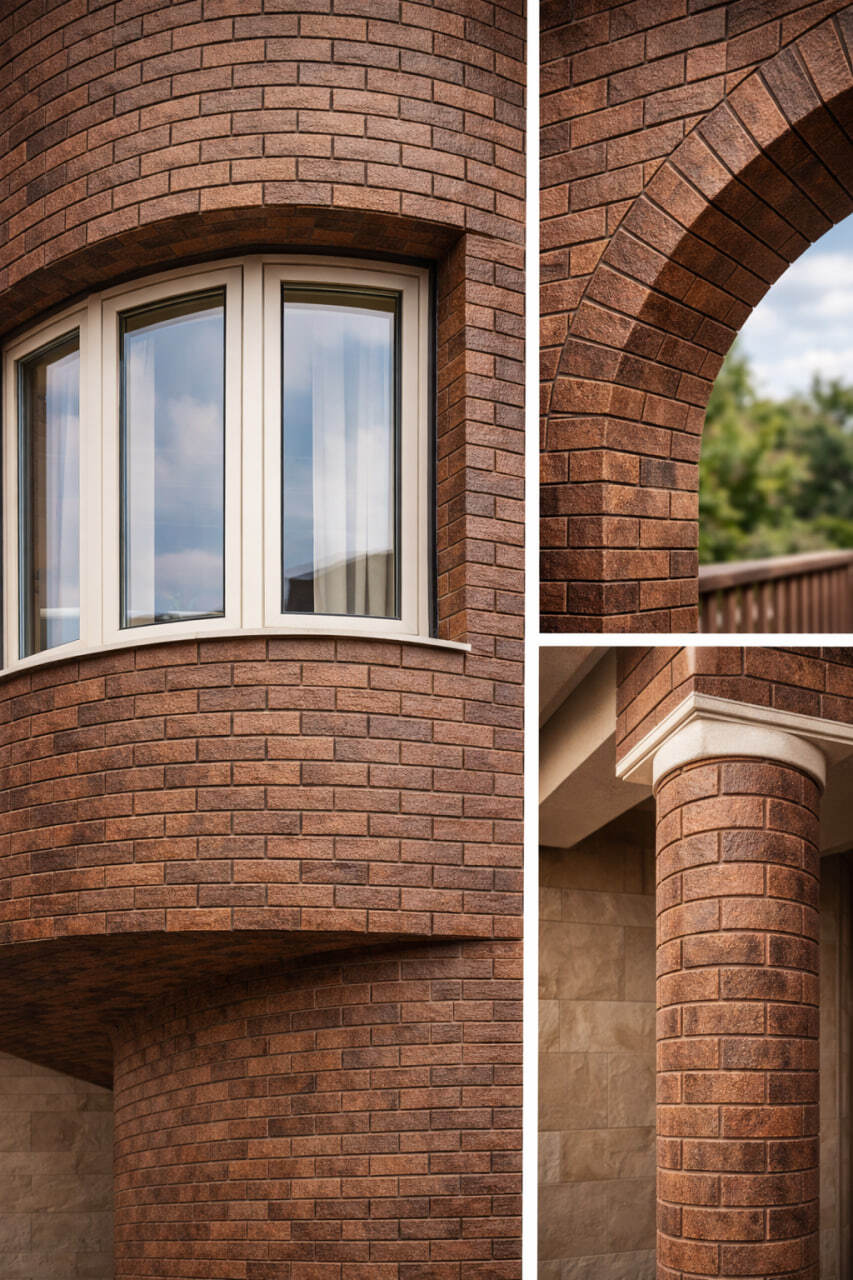
Modern architecture is increasingly moving away from flat, simple surfaces. Bay windows, curved walls, arches, columns, and complex façade elements make buildings more expressive—but they also complicate the choice of cladding materials. In such cases, flexible tiles demonstrate a clear advantage over natural stone, porcelain slabs, and traditional brick.
In this article, we explain why flexible tiles are the optimal solution for complex architectural forms and where they objectively outperform heavy materials.
Why Complex Shapes Are a Challenge for Traditional Materials
When cladding curved or non-standard elements with natural stone or rigid tiles, common problems arise:
- the need to cut each element individually
- a high percentage of material waste
- complex and uneven joint geometry
- risk of cracks at bends and transitions
- use of metal substructures
- additional load on the façade
The more complex the shape, the higher the cost of installation—and the greater the risk of mistakes.
The Key Advantage of Flexible Tiles
Flexible tiles adapt to the shape of the surface, instead of forcing architecture to adapt to the material.
Key characteristics:
- material elasticity
- low weight
- absence of rigid elements
- full-surface adhesive installation
This makes it possible to clad complex forms without cutting, without metal systems, and without adding structural load.
Curved Walls and Radius Facades
When applied to curved surfaces, flexible tiles:
- smoothly follow the wall curvature
- maintain even and consistent joints
- preserve the natural stone pattern
- avoid internal stress within the material
Unlike rigid tiles—where each piece must be cut at an angle—flexible tiles work as a continuous skin, evenly distributing load across the surface.
Bay Windows and Protruding Elements
Bay windows are among the most complex façade elements due to:
- multiple planes
- sharp and obtuse angles
- constant temperature fluctuations
Flexible tiles:
- wrap easily around corners
- do not require special trim elements
- maintain a unified visual appearance
- preserve the continuity of the insulated façade system
This is especially important in insulated façade systems, where any interruption can create thermal bridges.
Arches, Columns, and Decorative Elements
Natural stone on arches and columns:
- requires segmented cutting
- is difficult to align
- often results in uneven joints
Flexible tiles:
- follow the shape without breaks
- apply evenly along curved surfaces
- do not require reinforced substrates
- are suitable even for thin architectural elements
This makes them ideal for:
- columns
- arches
- niches
- decorative belts
- complex entrance groups
No Heavy Substructures Required
Stone and porcelain cladding often require:
- metal frameworks
- anchors and fasteners
- drilling through insulation
- wind load calculations
Flexible tiles:
- are installed with adhesive
- require no drilling
- do not damage insulation
- preserve a continuous façade system
As a result, the façade remains lightweight, warm, and technically correct.
Aesthetics Without Compromise
Modern flexible tile collections allow you to:
- replicate natural stone, brick, slate, or travertine
- preserve deep, realistic textures
- create a seamless pattern even on complex shapes
The façade looks monolithic—not fragmented, as often happens with heavily cut stone.
Where Flexible Tiles Are Especially Justified
Flexible tiles are ideal for:
- curved façades
- bay windows and protruding volumes
- arches and columns
- complex entrance areas
- architectural details
- renovation of old buildings
- insulated façade systems
Why KORDEKO Is the Right Choice for Complex Architecture
KORDEKO flexible tiles (PletaFlex):
- retain elasticity after installation
- do not crack on curves
- are resistant to moisture, frost, and UV
- require no metal substructures
- are suitable for both façades and interiors
- accurately follow complex forms without aesthetic loss
Conclusion
Curves, bay windows, and complex architectural forms are where flexible tiles clearly outperform stone.
They:
- simplify installation
- reduce labor and material costs
- preserve thermal insulation
- adapt to architecture without compromise
- deliver a durable and refined result
When architecture becomes complex, the material must be flexible. This is where flexible tiles show their full potential.
KORDEKO Contacts
📱 Phone: +37368140333
🌐 Website: www.kordeko.com
📧 Email: kordeko.md@gmail.com