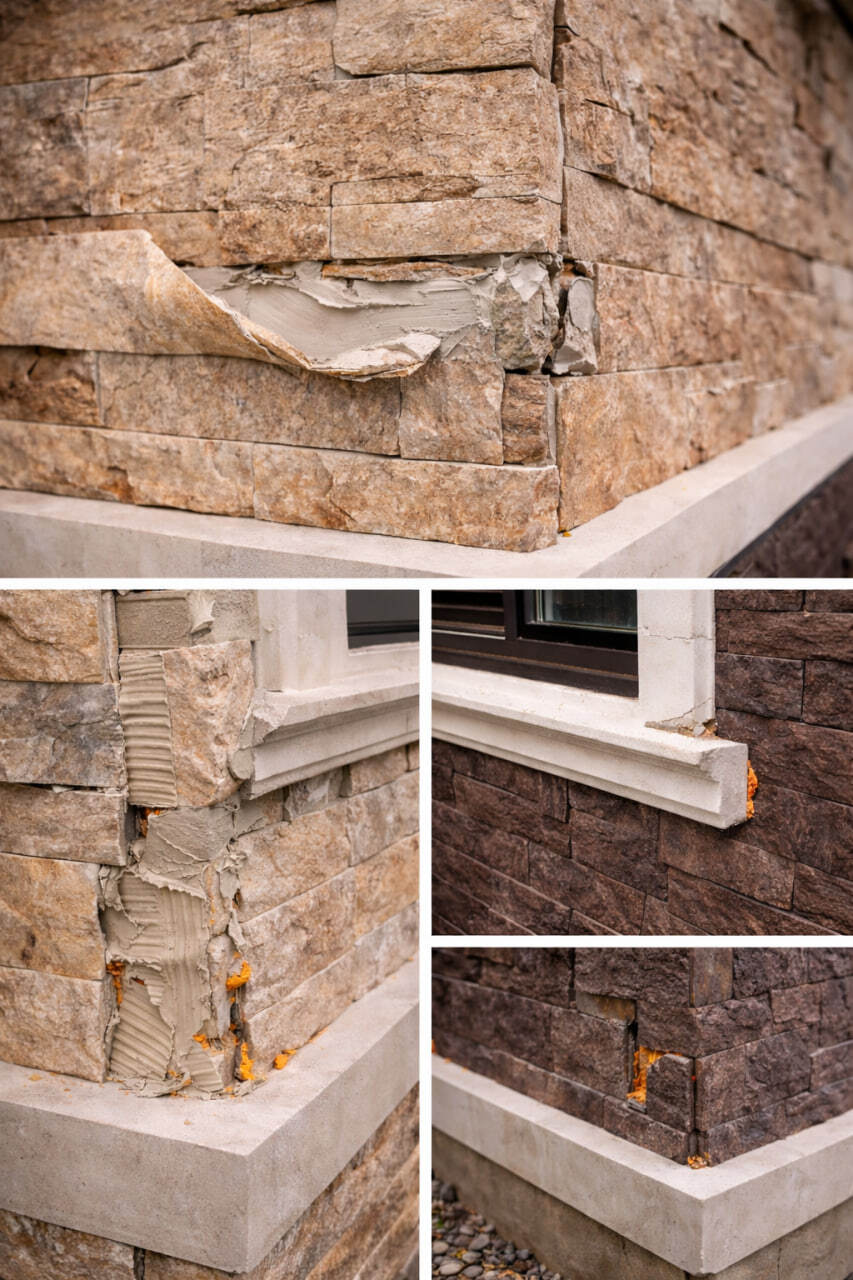
A good material will not save the result if the basic installation technology is ignored. On facades and in interiors, most problems do not appear immediately: the project may look fine “at handover,” but after one season (or even a few months), delamination, cracks, voids, stains, and unattractive joints begin to appear.
Below are the most common mistakes that can genuinely ruin the final result — and how to avoid them.
Mistake 1: Using the wrong adhesive “because it’s cheaper / because that’s what we always use”
Adhesive must be selected according to the task:
- exterior or interior use
- type of substrate (concrete, plaster, reinforced insulation layer)
- conditions (moisture, temperature fluctuations)
If the wrong adhesive is used, the result may be weak adhesion, overdrying, poor bonding, or failures after frost. For facades, exterior-grade and frost-resistant adhesives are a basic requirement.
Mistake 2: Skipping primer or using “something just for the sake of it”
Primer is not a formality. It:
- binds dust
- strengthens the substrate
- evens out absorption
- improves adhesive bonding
If primer is skipped, the adhesive may end up bonding to dust instead of the surface itself — and this is one of the most common causes of detachment. In installation recommendations, preparation and priming are mandatory steps.
Mistake 3: Uneven or weak substrate “the tile will hide everything anyway”
Texture may visually hide small imperfections, but it does not fix the geometry or strength of the base. If the wall:
- is uneven
- is crumbling
- has weak areas
- then the problem will inevitably show up: voids in some places, cracks in others, and in some areas the cladding will begin to come off.
The correct logic is simple: first the substrate must be solid and level, and only then should the cladding be installed.
Mistake 4: Working on a damp, dirty, or insufficiently cured surface
This is especially critical outdoors:
- after rain
- in high humidity
- on a fresh layer that has not yet gained strength
Moisture and dirt are direct enemies of adhesion. If the substrate is not ready, it is better to spend one more day on preparation than to redo the entire project later.
Mistake 5: Incorrect adhesive consistency and layer thickness
Too thick — poor contact.
Too runny — it slides, loses strength, and affects geometry.
Too thin — weak adhesion.
Too thick a layer — risk of shrinkage and joint problems.
Your recommendations directly emphasize the importance of proper consistency and correct application technology.
Mistake 6: Ignoring temperature conditions (summer / winter)
In hot weather, adhesive may dry out faster than it can properly bond.
In cold weather, it may fail to gain strength, and at subzero temperatures the structure of the adhesive layer may be damaged.
That is why installation conditions and the adhesive manufacturer’s recommendations are not “overcautiousness” — they are real protection for the final result.
Mistake 7: Poor detailing — corners, reveals, cornices, and transitions
On facades, problems most often appear in the details:
- corners
- junctions
- reveals
- transitions between planes
If there is no proper detailing logic, reinforcement, and accurate fitting, cracks and visible irregularities are almost guaranteed. This is especially important when Facade Insulation is involved, because the whole system must work as one continuous envelope.
How to do it right: a short checklist
- A solid and level substrate
- Mandatory priming
- The right adhesive for the task and conditions
- Proper consistency and correct adhesive layer
- Neat detailing and careful finishing
- Compliance with temperature requirements
If these points are followed, the result will be stable, clean, and long-lasting.
Why it is important to choose a material that works well within the installation system
Even the best installer appreciates a material that behaves predictably during installation and does not require “tricks” on every section. That is why for facades and complex areas, many professionals choose KORDEKO Flexible Tile (PletaFlex) — it is designed for practical installation technology and delivers a high-quality appearance when the substrate is prepared correctly.
KORDEKO Contacts
📱 Phone: +37368140333
🌐 Website: www.kordeko.com
📧 Email: kordeko.md@gmail.com