
Large windows make a house look modern, bright, and visually expensive. But this type of facade often has one common problem: if large smooth wall areas remain around the windows without rhythm or accents, the house can start to look empty, cold, and unfinished.
To make a facade with panoramic windows look complete, it is important to distribute texture, color, and architectural lines correctly.
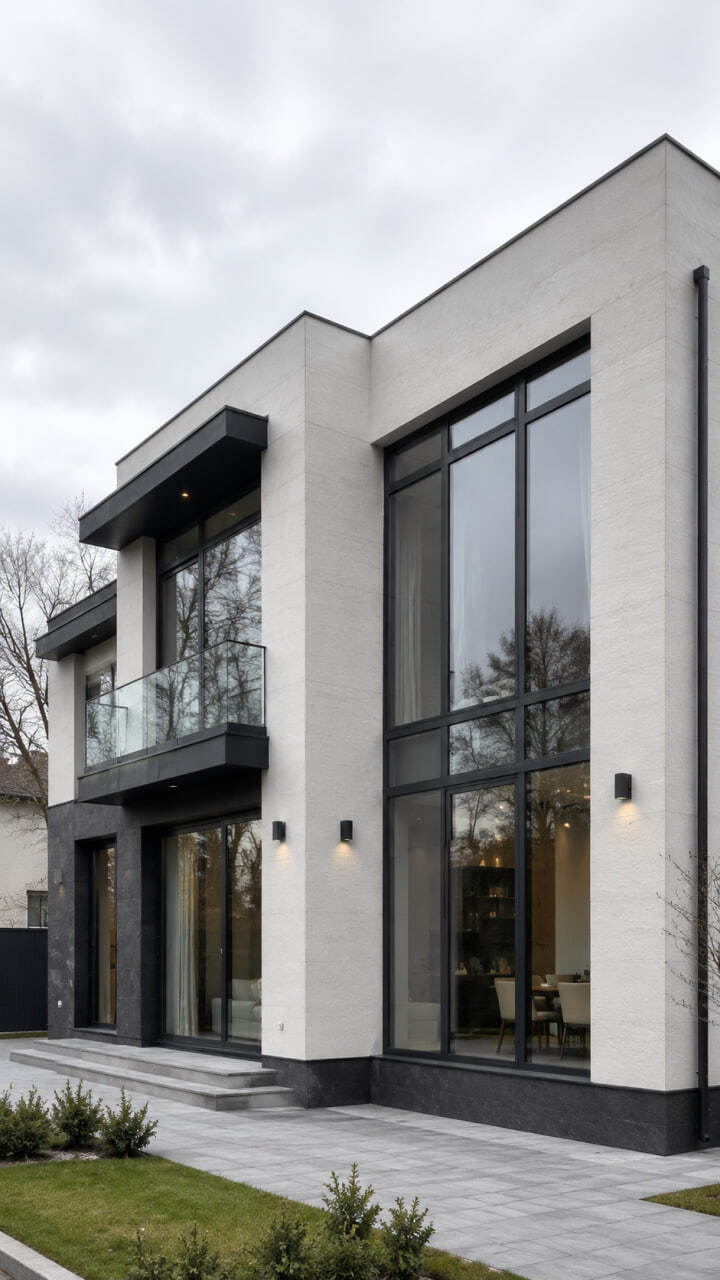
Why a Facade with Large Windows Can Look Empty
Panoramic windows are already a strong visual element. But if there is no support around them, the facade becomes unbalanced:
- too much glass and too little texture
- large plain walls look flat
- windows seem randomly “cut out”
- the facade loses depth and architectural character
That is why the purpose of the finishing is not to compete with the windows, but to carefully bring the facade together around them.
1) Create an Accent Zone Around the Windows
One of the best solutions is to highlight the area around large windows with a different texture. For example:
- a vertical block around a panoramic window
- a wide frame around a window group
- a textured insert between windows
- finishing on the wall section between the first and second floor
This makes the windows look like part of a well-planned composition, not separate openings in an empty wall.
2) Do Not Overload the Facade with Too Many Materials
A common mistake is trying to “save” an empty facade with too many colors and textures. As a result, the facade does not look stylish, but chaotic.
It is better to use 2–3 clear solutions:
- a calm main surface
- an accent texture
- a plinth or entrance area in a more practical shade
This helps the house look modern and expensive.
3) Support the Windows with Horizontal Lines
If the windows are wide, the facade needs horizontal elements:
- a belt line between floors
- a windowsill line
- a thin cornice element
- a horizontal textured insert
Horizontal lines visually connect the windows and remove the feeling of an empty wall.
4) Use Texture Where the Facade Needs Depth
Large smooth walls often look flat. Textured finishing helps add volume, especially:
- near the entrance area
- on wall sections between windows
- on the plinth
- on protruding parts of the facade
- in the terrace or balcony area
For these tasks, KORDEKO Flexible Tile (PletaFlex) is a good solution: it adds a stone texture to the facade without making it look heavy.
5) The Entrance Area Should Be Connected to the Windows
If a house has large windows, the entrance should not be left visually separate. Otherwise, the facade breaks into unrelated parts.
A good solution is to repeat the texture near the door, on columns, side walls, or the entrance portal. This makes the entrance area a logical accent, not a random detail.
6) The Plinth Helps “Anchor” the House to the Ground
Houses with large windows often lack visual stability, especially when the glass starts close to the ground.
The plinth solves this problem:
- makes the lower part more practical
- protects the facade from dirt and splashes
- visually strengthens the base
- helps the house look proportional
It is better to choose a plinth that is not too light, using natural stone shades such as grey, graphite, grey-beige, or warm stone tones.
7) If the Facade Is Insulated, All Accents Must Be Planned in Advance
When carrying out Facade Insulation, it is important to plan not only the thickness of the system, but also the external design: where the texture will be placed, where the belt lines will go, and how window reveals, corners, and joints will be finished.
If this is done “along the way,” the facade often turns out random: narrow cuts in some places, unnecessary joints in others, or lines that do not match.
Common Mistakes on Facades with Large Windows
- leaving large walls completely smooth
- using too many different textures
- not highlighting the entrance area
- forgetting about the plinth
- not connecting the windows with visual lines
- using accents only “for beauty,” without logic
Mini Checklist for a Good Facade with Large Windows
- the windows are connected by lines or texture
- there is an accent zone around the openings
- the plinth visually supports the house
- the entrance area does not look separate
- there are no more than 2–3 textures
- the facade looks complete from different sides
Conclusion
Large windows do not make a facade empty by themselves. A facade becomes empty when there is no composition. If you add the right textured zones, horizontal lines, a neat plinth, and connect the entrance with the overall style, the house will look modern, expensive, and proportional.
KORDEKO Contacts
📱 Phone: +37368140333
🌐 Website: www.kordeko.com
📧 Email: kordeko.md@gmail.com