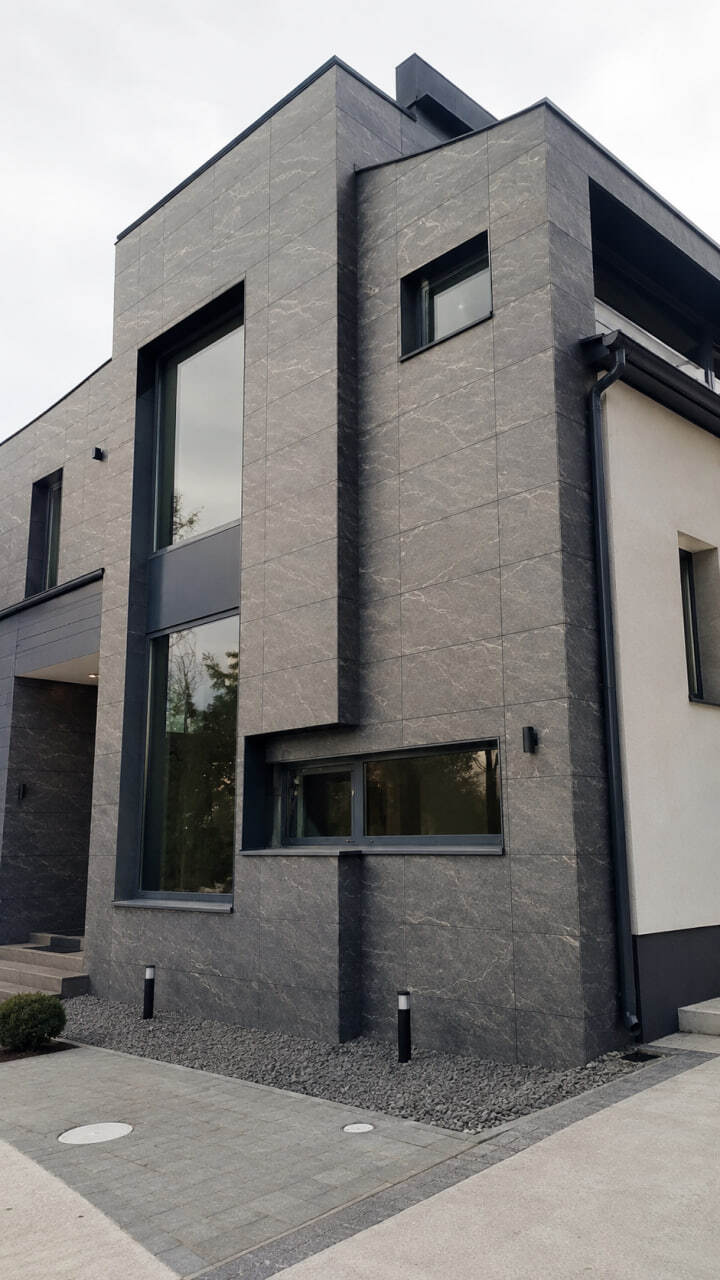
Uneven walls are a common issue both in new construction and renovation projects. The mistake many people make is trying to “hide everything” with the final finish — and as a result, the facade becomes wavy, window lines start to “float,” and the house looks cheaper. The right approach is different: unevenness should be concealed in a way that keeps the geometry visually straight.
1) First, separate two problems: “waviness” and minor surface roughness
- Minor surface roughness — scratches, small irregularities, slight level differences — can often be visually softened by texture.
- Waviness — plane deviations, uneven wall surfaces, tilted corners — cannot be fixed by texture. In fact, it will become even more noticeable in side light and along joint lines.
2) Golden rule: straight lines matter more than a perfectly flat wall
If the budget is limited, do not try to bring the entire surface “to zero.” It is better to ensure:
- straight corners,
- straight window reveals,
- straight lines along sills and lintels,
- neat transitions around the plinth.
These are the areas that create the impression of quality.
3) How unevenness is actually hidden without losing geometry
Marking and base reference lines
Before installation, reference lines are set: horizontal and vertical guides. The finish is then aligned to these lines instead of simply following the unevenness of the wall.
Local leveling instead of total leveling
Only the problematic areas are leveled:
- corners and edges,
- areas around windows,
- wall sections that face the street and catch side light.
Texture as a tool, not as a way to “hide everything”
A textured finish helps soften minor defects, but it must be applied over a predictable surface. Otherwise, the wall’s “movement” will still be visible.
4) Why facade geometry most often starts to “float”
Typical causes include:
- installation starts without marking and control lines,
- the adhesive layer varies in thickness,
- the substrate is not primed and the adhesive behaves inconsistently,
- straight lines are not maintained at corners and reveals.
When it comes to facade systems, this is especially important: Facade insulation requires an even reinforcing layer and correct junction details. Otherwise, unevenness and cracks will appear exactly at the connection points.
5) Which finish helps maintain a neat appearance on uneven walls
In practice, it is easier to work with a material that:
- allows clean lines on corners and window reveals,
- visually softens minor irregularities through texture,
- looks like a real material, not like random decorative plaster.
That is why, in renovation projects and facades with complex geometry, KORDEKO flexible tile (PletaFlex) is often chosen — it helps create a neat exterior appearance when the substrate is properly prepared and the lines are correctly set.
Mini checklist before starting the work
- Are horizontal and vertical reference lines marked?
- Are the corners straight and checked?
- Are the window reveals and areas around windows locally leveled?
- Is the substrate strong and primed?
- Are transitions planned in advance — plinth/wall, wall/flashing, and other junctions?
KORDEKO Contacts
📱 Phone: +37368140333
🌐 Website: www.kordeko.com
📧 Email: kordeko.md@gmail.com