
A house located near a road faces more than just dust and noise. Constant microvibrations from traffic can gradually affect the facade: small cracks may appear on corners, around windows, along material joints, and in connection areas. It is important to understand: vibrations rarely “destroy” the wall itself, but they accelerate the appearance of weak points in facade details and finishing layers.
Below is a practical scheme for making the facade more resistant and preventing microcracks.
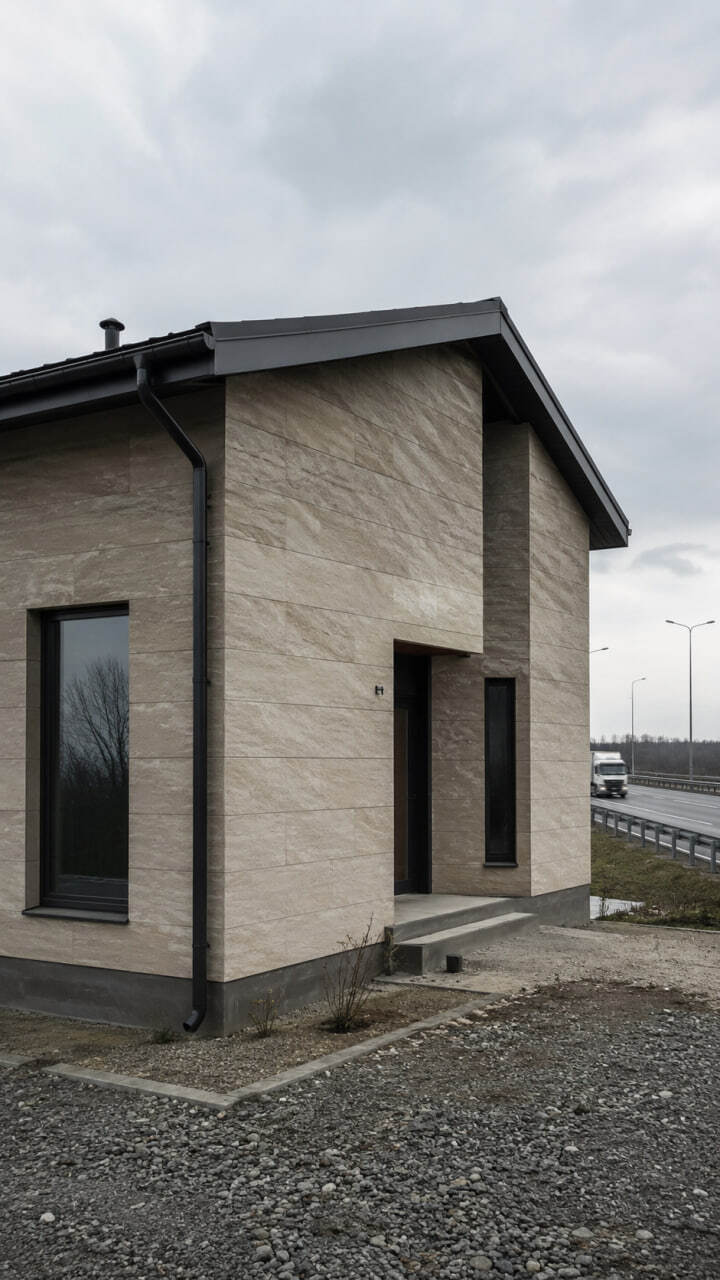
Why Vibrations Cause Cracks Mostly in Details
Vibration is a repeated small load. It first affects areas where tension already exists:
- corners and edges
- corners of window openings
- joints between different materials
- transitions between planes, such as plinth/wall or wall/cornice
- areas with different substrate stiffness
If the facade is assembled in separate weak sections, vibration will simply speed up the formation of cracks along those vulnerable lines.
1) Main Principle: the Facade Should Work as One Continuous Shell
For the facade to withstand micro-movements, the connection between all layers is essential:
- strong substrate
- proper primer
- suitable adhesive
- correctly designed facade details
If the base preparation is skipped, microcracks can appear even when a good finishing material is used.
2) Reinforcement: Where Strengthening Is Needed First
Even if the main facade surface is done correctly, risk zones must be reinforced:
- building corners
- window and door corners
- reveals
- transition to the plinth
- areas around fixings and canopies
If the facade is built as a system, the reinforcement must work continuously, without breaks, and with proper mesh overlaps.
3) Connection Details Are More Important Than Material Thickness
A common mistake near roads is thinking: “the thicker the material, the stronger it will be.” In practice, it is usually not the material that fails, but the connection detail:
- flashing
- canopies
- windows
- joints between layers
That is why proper sealing and correct geometry of facade details are often more effective than simply choosing the “strongest” material.
4) Water + Vibration = Faster Wear
If moisture gets into a crack, deterioration accelerates: wetting, temperature changes, expansion and contraction, and the crack opens even more. That is why, near a road, it is important that:
- flashing works properly
- water does not run down the wall
- the lower part of the facade is not constantly wet
5) If the House Is Insulated, the System Must Be Installed Correctly
On an insulated facade, weak areas appear faster: vibration combined with temperature cycles does its work. That is why Facade insulation must be carried out as a complete system, with correct details, reinforced corners, and proper substrate preparation.
6) Why Lightweight Cladding Is Often More Practical Near a Road
Heavy solutions increase the load on the facade layer and connection areas. Under vibration, this can increase the risk of problems in details and joints. Lightweight cladding usually:
- puts less load on the system
- is easier to work with around complex details
- is easier to repair locally if needed
That is why, in such projects, KORDEKO flexible tile (PletaFlex) is often used as a finishing layer: it is convenient for complex areas and helps the facade handle micro-movements more calmly when installed according to the correct technology.
Mini Checklist: Anti-Microcrack Protection for a House Near a Road
- corners and openings are reinforced without breaks
- continuous reinforcement with proper overlaps
- substrate is strong and primed
- correct adhesive is used for exterior conditions
- joints and connections are sealed without gaps
- flashing and drip edges work properly, and water is directed away from the wall
Conclusion
A house near a road does not require “super materials”; it requires a properly built system: reinforcement, correct facade details, sealing, and protection from water. If the facade is made as one continuous shell and details are not neglected, microcracks will not become a serious problem even under constant vibrations.
KORDEKO Contacts
📱 Phone: +37368140333
🌐 Website: www.kordeko.com
📧 Email: kordeko.md@gmail.com