
A cornice may look like a decorative detail, but in practice it is one of the most “stressed” junctions on a facade. Different planes meet here, projections appear, water can collect, and temperature-related movement is stronger. If the junction is done incorrectly, cracks most often appear along the cornice line or close to it.
Below is a clear explanation of why cracks appear and what needs to be done so that the cornice and finish work as one complete system.
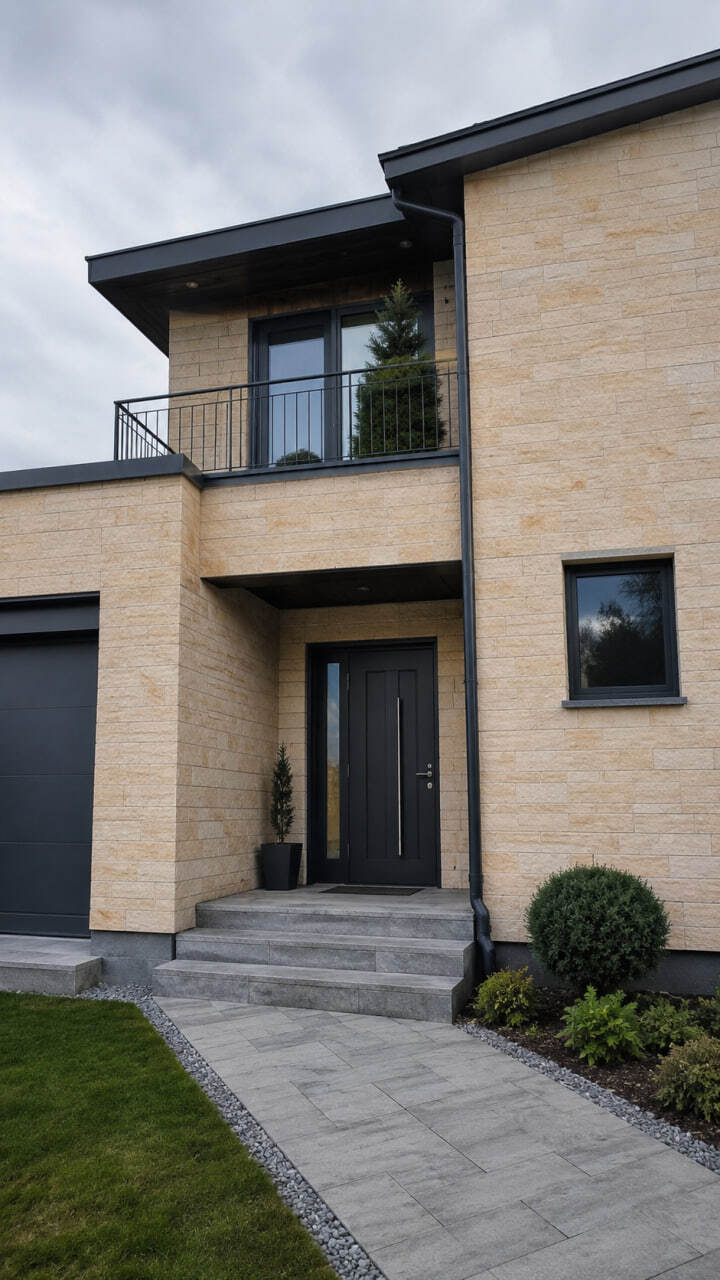
Why cornices crack more often than a flat wall
There are three main reasons:
- projections and edges are exposed to greater temperature and moisture changes
- different materials expand and contract differently
- water tends to collect on horizontal surfaces and “ledges,” increasing the load on the joint
That is why a cornice requires special attention to reinforcement and connections.
The most common mistake: “broken” mesh at plane transitions
A crack often appears not because the cornice itself is “bad,” but because the reinforcing layer is made in separate pieces:
- the mesh ends right on the edge
- there is no proper overlap
- the transition from vertical to horizontal is made “joint to joint”
- the corner is not reinforced
As a result, the facade does not work as one continuous shell, and the stress turns into a crack.
How to do it correctly: 6 solutions for the cornice junction
1) Reinforcement as one continuous shell
The mesh must pass over the edge and connect the planes. Overlaps are mandatory, without “saving a few centimeters.”
2) Reinforcement of corners and edges
A cornice is a stress concentration point, so the corners must be reinforced with corner profiles, additional mesh layers, or other reinforcements in risk zones.
3) Avoid “sharp” edges
Edges that are too thin and sharp crack faster. Better geometry and a neat edge give the facade long-term stability.
4) Water protection: drip edges and proper drainage logic
If water stays on the cornice, cracks and stains will appear faster. It is important that water drains outward and does not flow into the joint.
5) Proper preparation and primer
On a cornice, it is especially important not to apply adhesive “over dust.” The substrate must be strong, primed, and prepared according to the correct technology.
6) Control of temperature and working conditions
Projections are more exposed to temperature changes, so it is important to follow installation conditions and avoid working at the limit, especially in heat or damp weather.
Why cornice junctions are even more important on insulated facades
When a facade is installed over insulation, all layers must work together. If the cornice is made as a “separate element,” it becomes a weak point: the crack appears exactly where the load and water exposure are highest.
That is why Facade insulation must be treated as a complete system: reinforcement, overlaps, additional strengthening, and neat transitions help ensure that the cornice junction does not become a “break” in the facade contour.
How the finish affects the risk of cracks
The finish itself does not replace reinforcement, but it does influence how calmly the facade handles micro-movements and everyday use. On cornices, corners, and junctions, it is important to use a material that is practical and allows the edges to be finished neatly.
That is why KORDEKO flexible tile (PletaFlex) is often used in such junctions: it is convenient for detailed areas, helps cover complex zones neatly, and creates a clean, even appearance when installed according to the proper technology.
Mini checklist for accepting a cornice junction
- the mesh does not end on the edge and has proper overlaps
- corners are reinforced, with no “bare” joints
- the edge is even, without thin weak areas
- there is a clear drainage logic, such as a drip edge or slope
- the surface does not sound hollow, with no voids or early cracks
Conclusion
Cracks around cornices are almost always the result of an incorrect junction: broken mesh, weak corners, water exposure, and lack of reinforcement. If the reinforcement is made as one continuous shell and water drainage is provided, the cornice works reliably and does not become the weak point of the facade.
KORDEKO Contacts
📱 Phone: +37368140333
🌐 Website: www.kordeko.com
📧 Email: kordeko.md@gmail.com