How to choose a facade finish that makes a house look premium, lasts for decades, and doesn’t require constant repairs—especially on an insulated system.
What facade finishing is,and why it matters more than it seems
Facade finishing is not only about “looks”. It is the outer protective layer that takes the hit from:
- rain, snow, frost, and heat
- UV exposure and fading
- wind and humidity
- mechanical impacts (especially around the plinth and entrance)
If the finish is weak or installed with technology mistakes, you get cracks, delamination, stains, insulation getting wet, and ongoing repairs.
Common facade finishing options
1) Plaster and paint (ETICS / “wet facade”)
The most common option, especially over insulation.
Pros: budget-friendly, fast, easy to refresh color.
Cons: cracks may appear over time, fading, regular repainting, vulnerable to impacts and dirt.
2) Natural stone
Looks premium, but often requires reinforcement.
Pros: status, natural texture.
Cons: heavy weight, complex installation, high cost, not always suitable for insulated facades without structural solutions.
3) Brick and clinker
A classic look, but on insulation it can become a “heavy story”.
Pros: durability, “for decades” appearance.
Cons: weight, complexity, labor cost, risk of thermal bridges at junctions.
4) Ventilated facades (panels/cassettes)
Often used in commercial projects.
Pros: handles moisture well, durable.
Cons: expensive subframe, calculations, fasteners, complexity.
5) Flexible tiles (flexible stone) as the finishing layer
A modern facade finish, especially convenient over insulation.
Why KORDEKO flexible tiles are a strong facade-finishing solution
If you want a facade finish that looks like stone / brick / slate / wood, but without heavy substructures and constant maintenance, KORDEKO flexible tiles (PletaFlex) provide a practical balance.
What the owner gets:
- low weight — doesn’t overload the wall or insulation
- elasticity — better tolerates micro-movements of the substrate
- moisture and frost resistance
- UV stability — color holds in the sun
- minimal maintenance — periodic washing is usually enough
- installation on the reinforced base coat without metal frames
- ability to clad radiuses, arches, bay windows, and columns
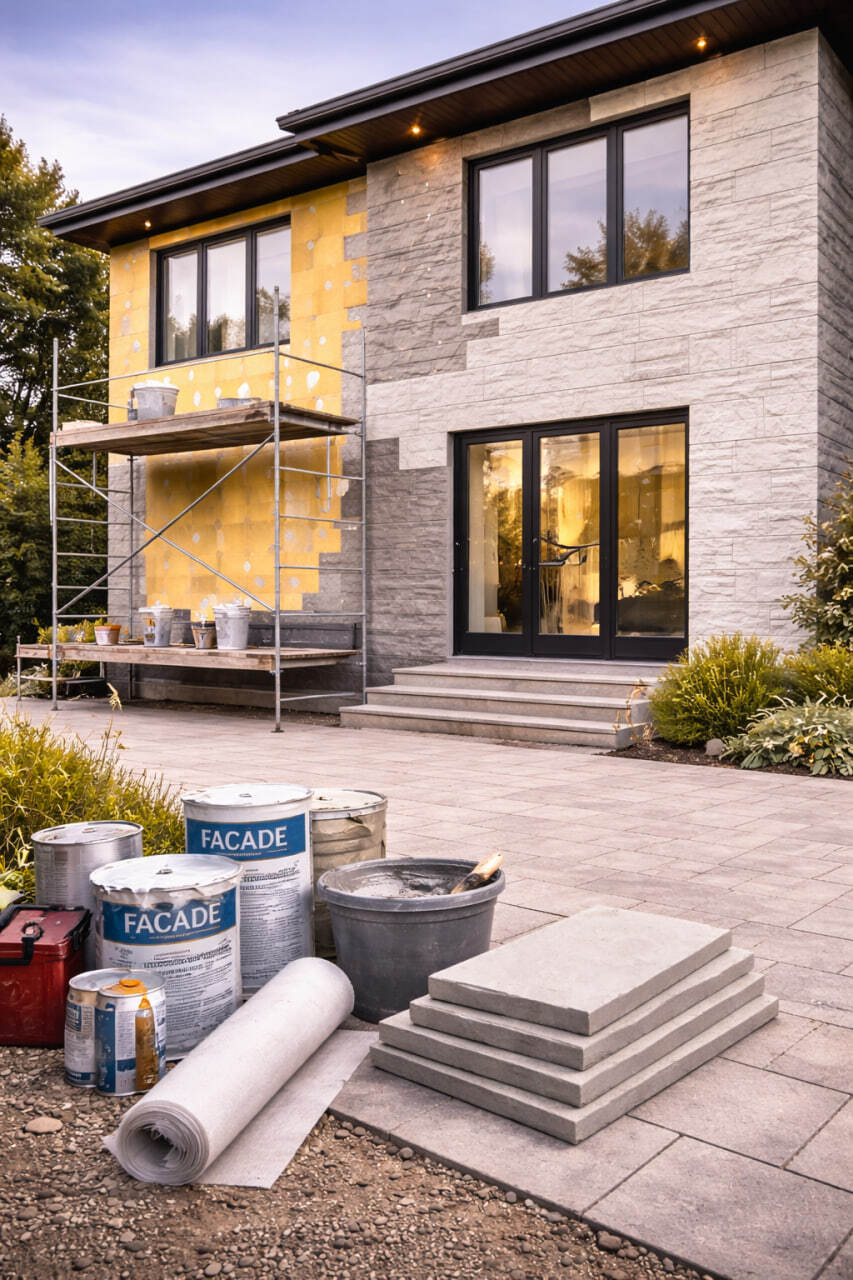
Facade finishing over insulation: the correct “layer cake”
For long-lasting performance, the system must be followed:
Load-bearing wall
Adhesive
Insulation (EPS or mineral wool)
Dowels
Reinforcement layer (adhesive + fiberglass mesh + reinforcements)
Primer
Facade finishing (for example, KORDEKO flexible tiles)
Important: the finishing layer is installed only after the reinforcement layer has fully dried.
Common mistakes in facade finishing
“Saved money” on substrate preparation
- The base must be even, strong, and dry
No primer
- Primer improves adhesion and reduces the risk of delamination
Wrong adhesive / incorrect consistency
- For facades you need frost-resistant adhesive; working consistency must follow the technology
Working in the wrong temperatures
- Follow adhesive manufacturer recommendations and protect the facade from rain/sun
Facade finishing must solve three tasks: beautiful, durable, practical.
If you want the look of natural materials but don’t want heavy structures and constant repairs, KORDEKO flexible tiles (PletaFlex) are one of the most convenient solutions for modern insulated facades.
KORDEKO Contacts
📱 Phone: +37368140333
🌐 Website: www.kordeko.com
📧 Email: kordeko.md@gmail.com