
When people complain about street noise, the first instinct is usually to “make the wall thicker” or “add some super-material.” But in reality, noise most often gets through not because of the wall surface itself, but through weak points: gaps, joints, window reveals, and any “holes” in the building envelope.
That is why a quiet home starts first with proper detailing and airtightness, and only then with the choice of finishing materials.
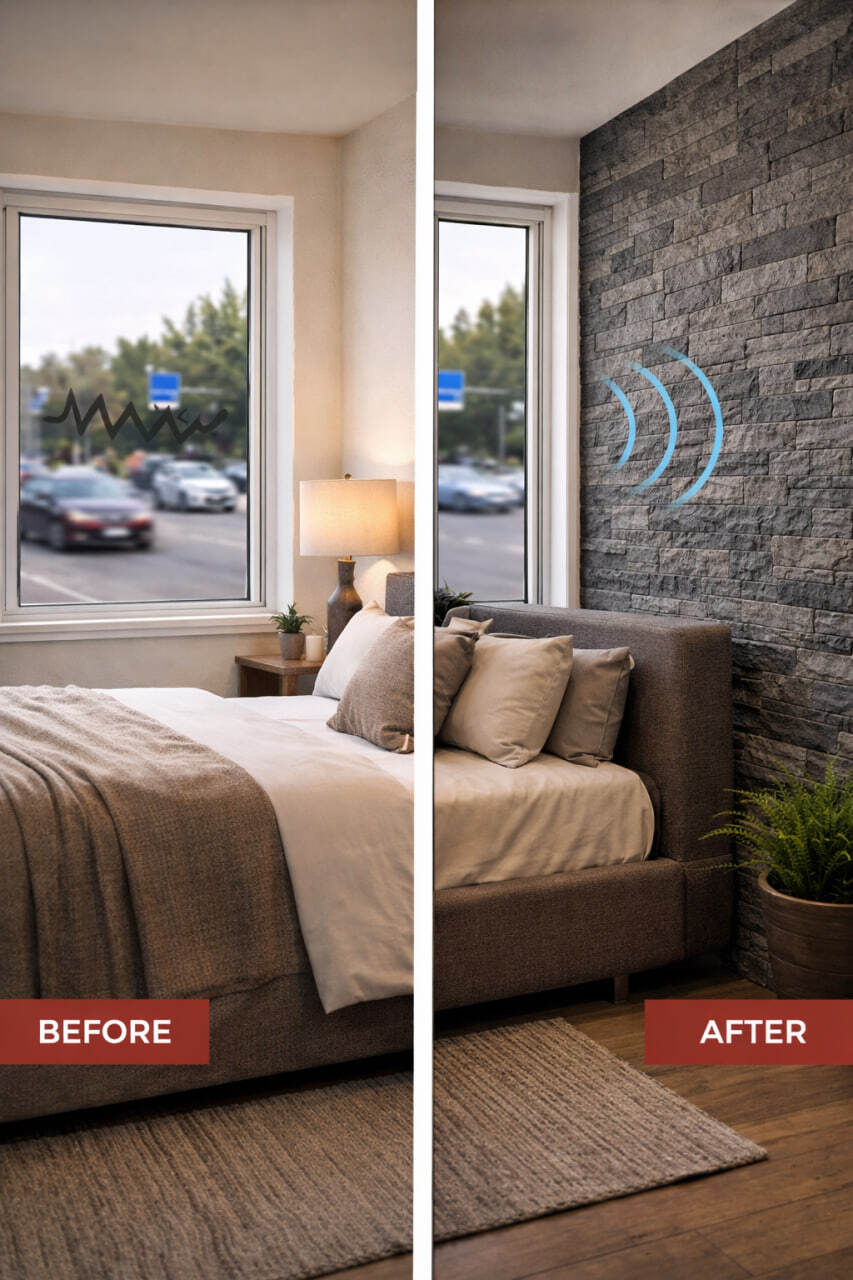
Why Noise Gets Through the “Holes” in the Building Envelope
Sound behaves a lot like water: it looks for the easiest path. If there are:
- gaps around window connections
- poorly sealed reveals
- cracks around service penetrations
- voids between construction layers
then even a thick wall will not guarantee silence. As a result, people change materials, while the real cause remains.
3 Details That Make the Biggest Difference
1) Windows and Reveals
This is the main entry point for noise. What matters is not only the quality of the window itself, but also how the reveal is built:
- tight connection to the frame
- no voids
- proper sealing of the joint
- a smooth, continuous surface without microcracks
2) Connections Between the Facade, Slabs, and Roof
These areas often contain hidden gaps that are not visible from the outside. If the building envelope is not properly sealed, noise will still enter the house even if the walls themselves are good.
3) Service Penetrations
Coaxial pipes, ventilation ducts, cables — all of these are points where “holes” are often left behind. They must be properly sealed and finished, otherwise sound will travel through them easily.
Airtightness Matters More Than “Thickness”
A common mistake is focusing on material thickness while ignoring the joints. But the joints are often what create the feeling that “the window is slightly open.” That is why:
- sealants and tapes must be suitable for exterior conditions
- joints must be closed so there is no air leakage
- any cracks or voids will become future sources of noise
How a Facade System Helps Reduce Noise
Quietness comes from a combination of:
- mass (walls/slabs)
- airtightness (eliminating gaps)
- layering (a properly designed wall build-up)
This is where Facade Insulation often helps not so much as a “soundproofing material,” but as a stabilizing system: when the facade is built as a full system, air leakage is reduced, weak points are closed, and the airtightness of the envelope improves.
Why the Finish Layer Also Matters
The finish layer does not make a house “soundproof” by itself, but it does affect the long-term durability of the details. If the finish cracks or ages quickly, microcracks and weak points can reappear, leading to air leakage — and with it, noise.
That is why, in projects where clean detailing and stable performance matter, KORDEKO Flexible Tile (PletaFlex) is often used: it is convenient for junctions and helps neatly finish complex areas when installed according to technology.
Mini Checklist for a “Quiet Facade”
- Windows are installed with proper sealing
- Reveals are finished without voids or cracks
- All service penetrations are sealed
- The facade envelope is fully closed at roof/slab junctions
- The finish layer does not develop microcracks and protects the details
Conclusion
If you want a quiet home, start not with “the most expensive material,” but with the details: window reveals, junctions, sealing, and closing every “hole” in the building envelope. These are the elements that make the biggest difference in reducing street noise.
KORDEKO Contacts
📱 Phone: +37368140333
🌐 Website: www.kordeko.com
📧 Email: kordeko.md@gmail.com